Well this wraps up a little more than a month in Singapore, Lao and, mostly, Vietnam. Leaving aside Singapore, which feels a bit like it was dropped into place from outer space, these places are strange to visit for the first time as a Canadian born in the 50s. Lao, Cambodia and Vietnam (then North and South), and what to us was the Vietnam War, were the daily news when we were kids, and in high school, and in university. Names of tiny villages (like My Lai), things (like the Ho Chi Minh Trail), chemical weapons (like napalm and Agent Orange) and events (like the Tet Offensive) were common knowledge. As were the images seen in magazines and on TV news. But the western oppression started long before that, with the Church and the French doing their bit pretty effectively for a lot of years before the US had its turn.
We wondered what it would be like to visit such places, and how people there viewed the period before (and after) reunification 50 years ago. So we listened a bit, and we asked a bit. And we learned a bit. Mostly from our guides, who were in their early or later 30s. Many had families on both sides of the North/South conflict of the 60s and 70s – one had a grandmother who was a Viet Cong guerrilla in the south who married a South Vietnamese army officer (after he was sent away for reeducation). Several used language that looks like awkward propaganda speech when written (the “puppet king” or the “puppet president” or the imprisonment of “patriots”) but which came off totally normally in conversation – just an (accurate) adjective, like referring to Louis XIV as the Sun King, and said without rancour. And in one of those small “duh” lightbulb moments we heard the triumphant entry of the North’s troops into Saigon in 1975 referred to not as the victory of the North but rather as the “liberation” of the South, which seemed odd at first since we had grown up being told that the war was to defend the South.
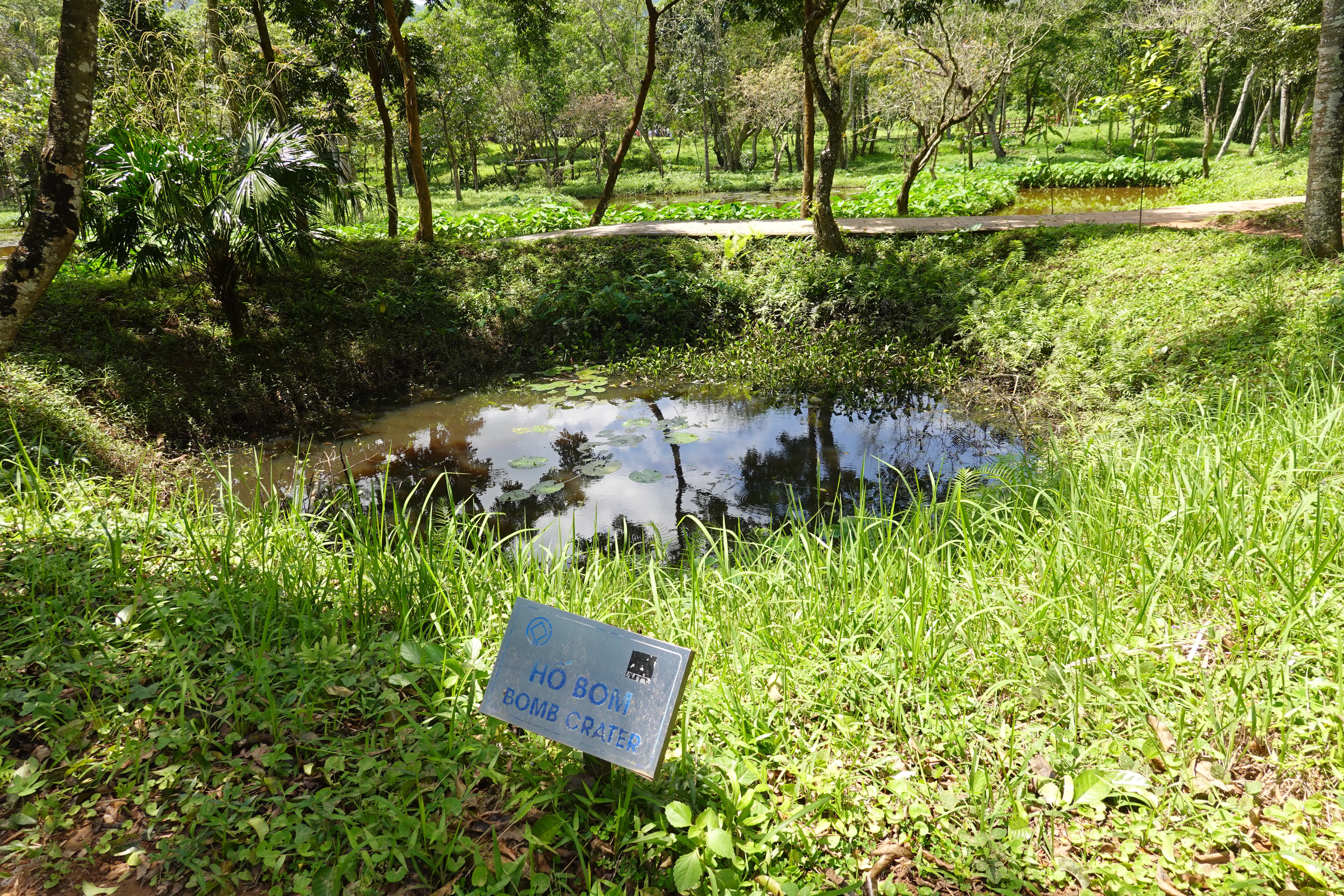
When we asked about how all of that left people feeling in 2025 we got similar replies: that it is important to remember the past, but also important to look to the future. But the past is everywhere, and it would be hard, and unfortunate, to try to avoid it as a visitor. The UXO centre in Lao; the notorious prison in Hanoi, built by the French and now a museum to colonial cruelty; the bomb craters at the Cham temple complex, marked with the same signage as the temples the bombs partly destroyed; the Cu Chi tunnel complex outside Saigon, now a museum to the ingenuity of the underdog; the monument to the Buddhist monk who famously immolated himself in a Saigon intersection in 1963 to protest the suppression of Buddhism by the Catholic puppet president; and the Remnant Museum in Saigon, with its unblinking photo-forward approach to the American War that is frank and unbearable. The past also lies in a northern guide’s grandmother, who lost an arm and never thrived, and in a Saigon guide’s lament that the South was abandoned.
Yet the future feels very much what it is really all about. People don’t grouse much about their single party government, and instead note that it practises a brand of “flexible” communism that has allowed people to move from bicycles to scooters and cars and in which people seem to the outsider to be able to engage in whatever small scale business they choose. Or large scale – we were told incessantly about the country’s richest man, whose finger seems to be in every pie, with one guide proudly telling us how many spots the guy had moved up in the Forbes rankings. They didn’t seem to venerate him – more than one hinted that there was a private quid for every government quo – but did seem jazzed by the fact that he was able to make such a mark.
Anyhow. All to say that this was not like being in the Dordogne and hearing about the Hundred Years War. The past is pretty recent in this part of the world, and it is our past too, just from the other side of the coin. It was an important part of the visit, and one that made it richer.
And that, as they say, is that.


 Back to Beyond
Leave a reply to iamwtw Cancel reply